What Is a Match Cut? A Detailed Introduction to One of Film's Most Powerful Editing Techniques

Table of Contents
- Why Match Cuts Matter
- How a Match Cut Works
- What Are the Different Types of Match Cuts?
- What Is a Match on Action Cut?
- What Is the Difference Between a Match Cut and a Jump Cut?
- What Are the 7 Types of Cuts in Film Editing?
- Final Thoughts
- Frequently Asked Questions
- Spotlight FX - Get free transitions, effects and workflow tools
A match cut is a transition between two shots where elements such as action, composition, color, or sound are matched to create a seamless or meaningful connection between scenes.
It is one of the most fundamental tools in a video editor's toolkit, used to maintain continuity, suggest the passage of time, or draw a thematic comparison between two completely different moments.
Why Match Cuts Matter
Most viewers do not consciously notice a well-executed match cut, and that is exactly the point. When done right, the edit disappears. The story keeps moving, the emotion stays intact, and the audience remains fully immersed in the scene.
But match cuts do more than just hide edits. They can carry meaning. The most famous example is from Stanley Kubrick's 2001: A Space Odyssey, where a bone thrown into the air cuts directly to a spaceship floating in orbit. In a single edit, millions of years of human evolution are compressed into one visual idea. That is the power of a match cut used at its highest level.
For video editors working on YouTube videos, short films, or music videos, match cuts are equally valuable. They make your work feel polished, intentional, and professional, even when you are working with limited footage or a tight timeline.
How a Match Cut Works
A match cut works by finding a visual or audio connection between two shots and using that connection as the bridge between them. The human eye is naturally drawn to movement and shape, so when two shots share a similar composition, motion, or sound, the brain reads them as connected, even if the scenes are completely different.
The basic process looks like this:
- You identify a visual or audio element in shot A (a shape, a movement, a sound)
- You find a matching element in shot B
- You cut at the moment where those two elements align
The result is a transition that feels intentional rather than abrupt, guiding the viewer from one moment to the next without breaking the flow of the story.
What Are the Different Types of Match Cuts?
Match on Action
A match on action cut (also called cutting on action) transitions between shots by cutting during a character's movement, making the action appear continuous despite the change in angle or scene.
For example, a character begins opening a door in one shot, and the next shot picks up the action from a different angle as the door swings open. The movement connects the two shots seamlessly.
Graphic Match
A graphic match cut connects two shots based on their visual composition, such as similar shapes, colors, or overall framing.
Unlike a match on action, a graphic match is often intentionally noticeable because the goal is to draw a thematic or metaphorical comparison between the two images. The bone-to-spaceship cut from 2001 is a graphic match.
Sound Bridge (Audio Match)
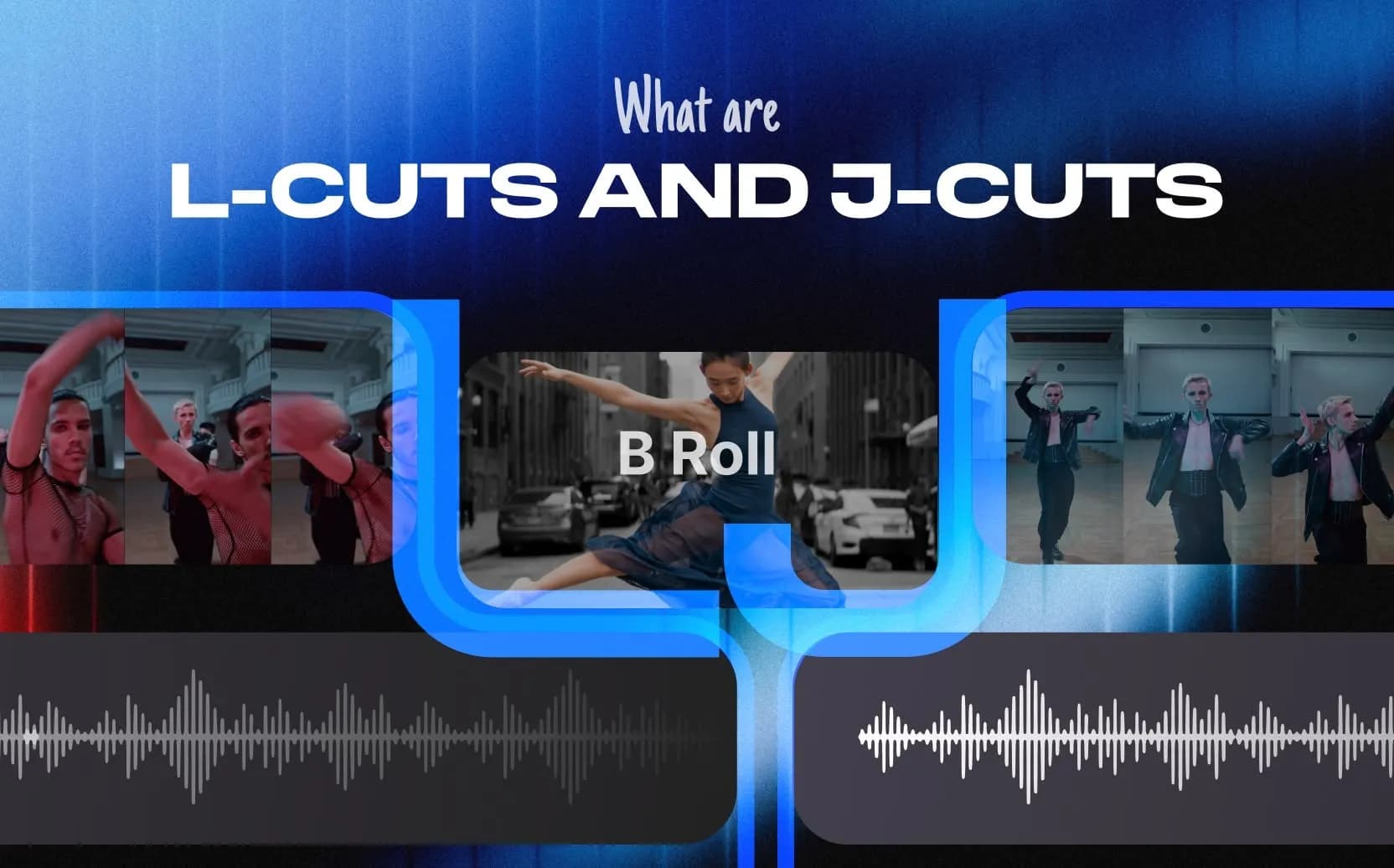
A sound bridge uses audio to connect two scenes. The sound from the next scene begins before the visual cut happens (a J-cut), or the audio from the previous scene continues after the visual has already moved on (an L-cut).
Either way, the audio acts as the matching element that ties the two shots together.
What Is a Match on Action Cut?
A match on action cut is a specific type of match cut where the editor cuts between two shots at the exact moment a movement begins or continues. The action flows from one shot to the next without any visible interruption, even if the camera angle, location, or time has changed.
Some well-known examples include:
- Indiana Jones and the Last Crusade: Young Indy grabs his hat, and the cut takes us directly to adult Indy doing the same gesture, linking the two versions of the character through a single action.
- John Wick: Gunshots, reloads, and strikes are cut on action throughout fight sequences to build intensity and keep the choreography readable.
- Kill Bill: A sword swing cuts to a low-angle shot of the impact, amplifying the drama of the fight.
The key to pulling off a match on action cut is timing. You need to cut at precisely the right frame so the movement feels unbroken across both shots. Shooting multiple takes of the same action from different angles gives you the flexibility to find that perfect cut point in the edit.
What Is the Difference Between a Match Cut and a Jump Cut?
Match cuts and jump cuts are essentially opposites in terms of intent and effect.
Aspect | Match Cut | Jump Cut |
|---|---|---|
Transition Style | Smooth and intentional | Abrupt and jarring |
Continuity | Maintains or builds on it | Breaks it deliberately |
Audience Focus | Hides the edit | Highlights the edit |
Purpose | Thematic links, seamless flow | Time compression, urgency, energy |
Common Use | Narrative films, music videos | Vlogs, talking-head videos, action |
A match cut says: you should not notice this edit. A jump cut says: notice this edit, it means something. Both are valid tools, but they serve very different storytelling purposes.
What Are the 7 Types of Cuts in Film Editing?
If you are learning film editing, these are the seven cuts you will encounter most often:
- Straight Cut (Hard Cut): The most basic edit. One shot ends, the next begins. No effects, no overlap.
- Jump Cut: An abrupt edit that removes a segment of time, creating a sudden skip in the footage.
- Match Cut: A transition that connects two shots through matching visual or audio elements.
- Cross-Cut (Parallel Editing): Alternates between two or more scenes happening simultaneously in different locations.
- Cutting on Action (Match on Action): Cuts from one shot to another while a subject is mid-movement to create seamless flow.
- J-Cut and L-Cut: Audio and visuals overlap between scenes. In a J-cut, the next scene's audio starts before the visual cut. In an L-cut, the previous scene's audio continues after the visual has moved on.
- Smash Cut: A sudden, high-contrast transition used for shock, comedy, or dramatic emphasis.
Each of these cuts has a specific job. Knowing when to use which one is what separates a good editor from a great one.
Final Thoughts
A match cut is a transition between two shots connected by a shared visual or audio element, and it is one of the most effective tools for creating smooth, meaningful edits. Whether you are using a match on action to maintain continuity in a fight scene, a graphic match to draw a thematic comparison, or a sound bridge to carry emotion from one scene to the next, the match cut gives your editing intention and craft.
Understanding the difference between a match cut and a jump cut, and knowing all seven types of cuts available to you, puts you in a much stronger position as an editor. The more deliberate your cuts, the more professional your final video will feel.
Frequently Asked Questions
What is a match cut?
A match cut is a film editing transition that connects two shots by matching a visual or audio element between them, such as a movement, shape, color, or sound, to create a seamless or thematically meaningful connection.
What is a match cut in film?
In film, a match cut is used to maintain continuity, compress time, or draw a comparison between two scenes. The most iconic example is the bone-to-spaceship cut in 2001: A Space Odyssey, where a prehistoric bone thrown into the air cuts directly to a spacecraft in orbit.
What is a match on action cut?
A match on action cut is a type of match cut where the editor cuts between two shots during a continuous movement, making the action appear uninterrupted even if the camera angle or location has changed. It is one of the most common techniques in continuity editing.
What is the difference between a jump cut and a match cut?
A match cut creates a smooth, seamless transition by connecting two shots through shared visual or audio elements. A jump cut is the opposite: it is an abrupt, intentionally discontinuous edit that breaks continuity to compress time or create a jarring effect.
What are the 7 types of cuts in film editing?
The seven most common types of cuts are: straight cut, jump cut, match cut, cross-cut, cutting on action, J-cut and L-cut, and smash cut. Each serves a different storytelling purpose and creates a different effect for the viewer.
Related Posts
 Video Editing